

Let’s be honest: walking into an open house is a form of psychological warfare. You are greeted by a tray of cookies, a $400 Nest candle that smells like Financial Stability, and a soundtrack of lo-fi beats designed to lower your cortisol levels. The staging is impeccable. There’s a throw blanket artfully draped over a sofa that costs more than my first truck, and every Live, Laugh, Love sign is strategically placed to hide a hole in the drywall.
Sellers are profiling their houses like dating apps. They’re showing you the best angles, the most flattering light, and hiding the fact that the HVAC system sounds like a jet engine clogged with seagull feathers.
As your home inspector, it’s my job to be the professional “buzzkill.” I am the guy who walks into your potential dream home and immediately starts looking for the nightmare lurking below the surface. I don’t care about the quartz countertops or the subway tile backsplash. I care about the stuff that keeps the roof over your head and the water out of your toaster.
Buying a house is like a high-stakes first date: everyone is on their best behavior until you look in the crawlspace and realize the house has some serious “ex” issues.
If you’re out house hunting and you spot any of these six red flags, don’t let be dazzled by the staging. Don’t panic, but do have my number on speed dial! We’re going to need to do some detective work.
#1 The Spicy Electrical Panel
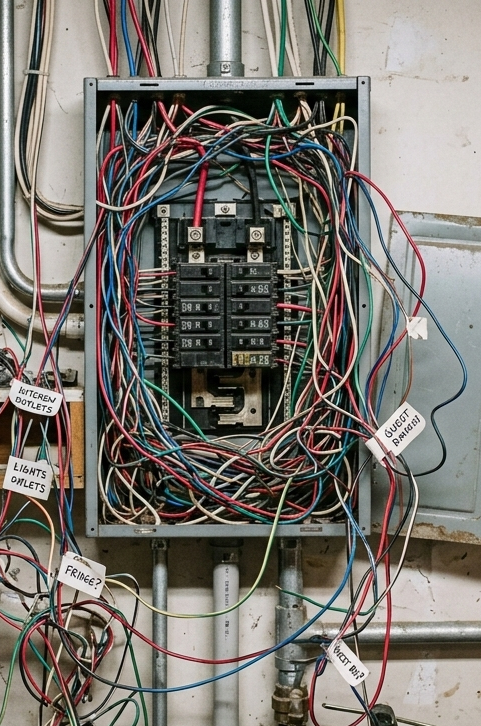
When I open an electrical panel, I should see a neat, organized rows of breakers. What I often find instead is what I like to call The Bowl of Angry Spaghetti.
DIY Electrical is the leading cause of me having an anxiety attack on the job. Homeowners love to think they’re electricians because they watched a twenty-minute YouTube video. They start adding outlets, wiring up “smart” light switches, and running extension cords through the attic like it’s a jungle gym.
- The Red Flags: I’m looking for “double-tapping” in the breaker box (where some genius jammed two wires into a slot meant for one) or charred, melted plastic on the breakers. That’s not “character”—that’s an active fire hazard.
- The “Panel of Doom”: If I see the words Federal Pacific or Zinsco on the front of that box, we have an immediate problem. These panels are the vintage “fire-starters” of the industry. They are famous for failing to trip when they overheat, which is basically the electrical equivalent of a car that doesn’t have brakes.
Replacing an electrical panel isn’t the end of the world, but it’s a $2,500+ conversation you need to have before you close.
#2 The Fresh Paint Smell (Everywhere)
If you walk into a basement or a spare bedroom and it smells like a Sherwin-Williams factory just exploded, your Spidey Sense should be tingling. This is what we in the industry like to call “The Landlord Special.” Fresh paint is a classic “homeowner’s highlighter.” It’s often used to draw a nice, crisp, white line right over mold, mildew, or a water stain the size of a Rottweiler. Now, don’t get me wrong—sellers should paint before they list. It’s part of the game. But when I see fresh paint in a basement that has no windows and questionable drainage, I start reaching for my moisture meter.
- The Reality Check: I’ve seen cases where a seller painted over black mold just forty-eight hours before the inspection. It looks great for the photos, but the moisture is still there, trapped behind the “Swiss Coffee” semi-gloss, just waiting to rot the studs.
- Pro Tip: Look at the ceiling corners and the baseboards. If there’s a suspiciously circular patch of “extra white” paint, or if the texture of the drywall feels slightly “mushy” or bubbly, someone is trying to hide a leak from the upstairs bathroom or a failing roof.
#3 The Lasagna Roof Recipe
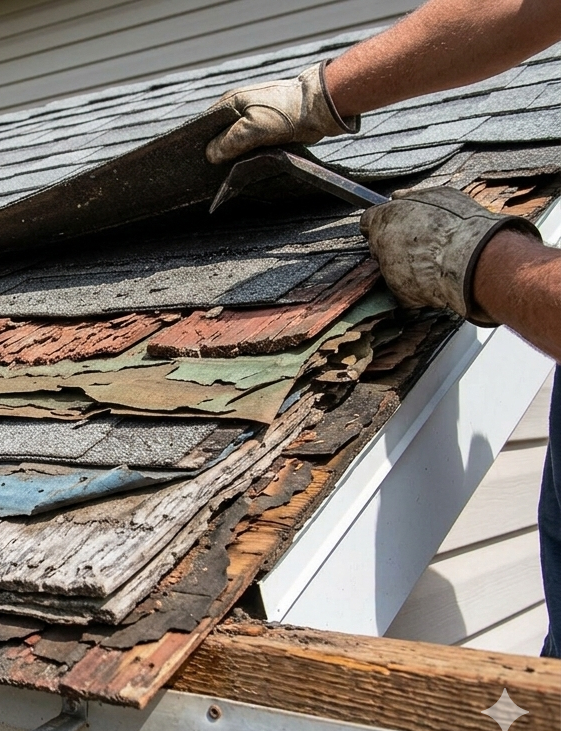
Did you know you can keep layering shingles on a roof like you’re dressing for a particularly brutal North Dakota winter? You can, but you absolutely shouldn’t.
If you look at the edge of a roof and it looks abnormally thick (like a piece of lasagna, that’s a major red flag.
Most municipalities allow for two layers of shingles, but I’ve seen three or even four.
- The Physics Problem: Shingles are heavy. A single layer of shingles on a standard house can weigh several thousand pounds. When you double or triple that, you are putting massive, unintended stress on the rafters and the structure of the home.
- The Insurance Nightmare: Here’s the kicker: most insurance companies in 2026 are getting extremely picky. If they see a roof that’s over fifteen years old or has multiple layers, they might refuse to insure the home entirely.
- The Hidden Cost: You can’t just put a new layer over a mess. To fix it properly, you have to pay for a “tear-off,” which means paying a crew to rip off all those layers and haul them to the dump before they even start the new roof. It essentially doubles your labor costs.
#4 Stair-Step Cracks in the Brick
A little settling is normal. Houses are heavy, the earth moves, and over thirty years, things are going to shift. Houses get old, their joints creak, and they get a bit cranky, much like I do when I have to inspect a hot attic in July.
However, there is a very big difference between a “hairline settlement crack” and a “structural SOS.” If you see a crack in the exterior brick or the interior foundation wall that looks like a literal staircase, the house isn’t just settling; it’s trying to return to the earth.
- The Science of the Squeeze: Vertical cracks are often just the house breathing. But stair-step cracks (following the mortar lines) or horizontal cracks are signs of “lateral pressure.” This means the soil outside is pushing against the foundation, or the corner of the house is sinking into a soft spot.
- The “Rule of Thumb”: If the crack is wider than 1/4 inch, or if I can see the neighbor’s backyard through the wall, your bank account is about to have a very bad day. Foundation repair often involves “piers” or “underpinning,” which are fancy industry code words for we have to dig a giant hole and charge you ten thousand dollars.
#5 The Indoor Swimming Pool In the Crawlspace
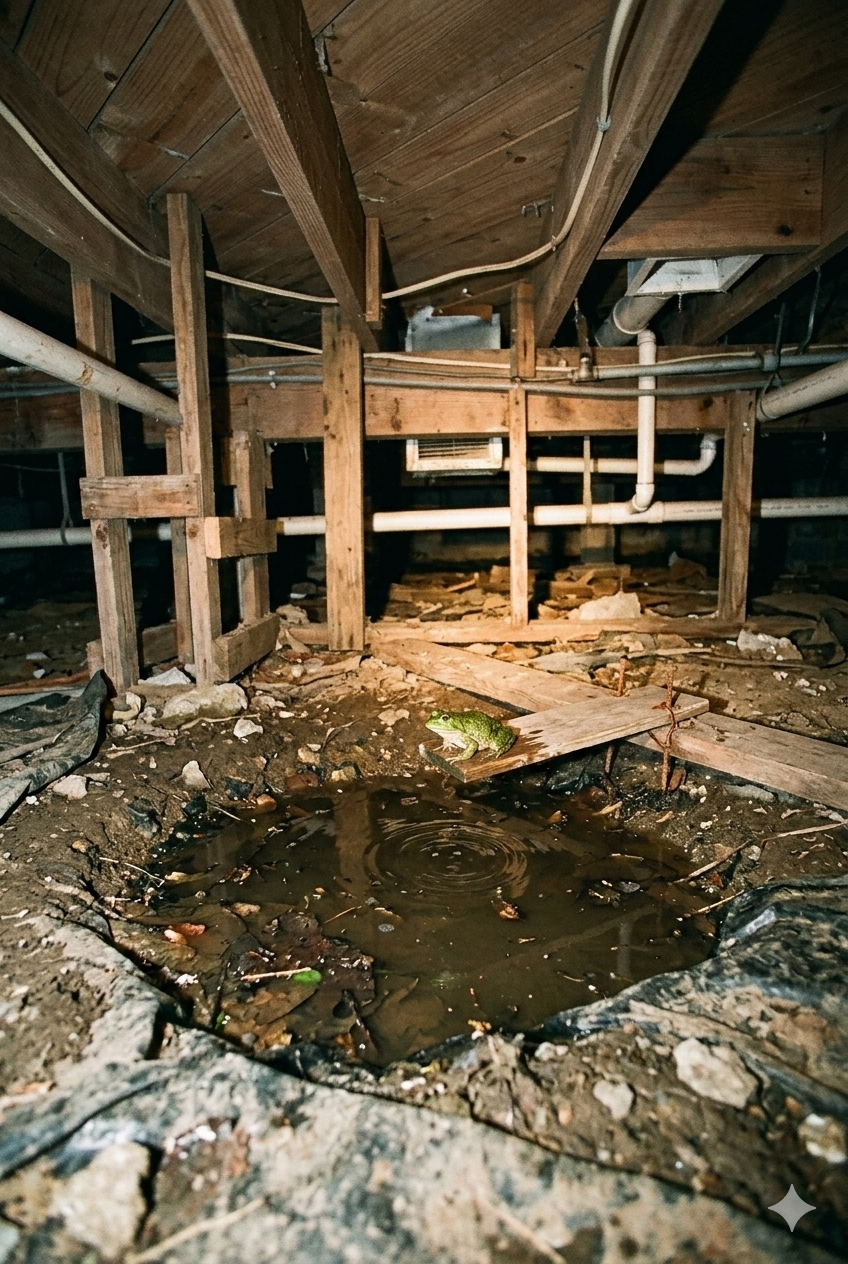
I’ve spent a significant portion of my life in crawlspaces, and I can tell you that they are the “underbelly” of the housing world.
If I open that hatch and I’m greeted by the smell of old gym socks or worse, a family of frogs splashing, we’re in trouble.
Standing water under a house is a VIP invitation for every nightmare known to man: mold, wood rot, termites, and a guest list of pests (raccoons, opossums, and the aforementioned frog clan) that you definitely didn’t invite to the housewarming party.
- The Evidence: Even if the crawlspace is dry today, I look for efflorescence. That’s the white, chalky powder left behind on concrete walls. It’s the “ghost of water past,” and it tells me exactly how high the water gets when it rains.
- The Rot Factor: Wood is a sponge. If it sits in a high-humidity environment for years, it loses its structural integrity. If I can poke a screwdriver into your floor joist and it goes in like a hot knife through butter, we aren’t talking about a “fixer-upper” anymore—we’re talking about a major structural failure.
#6 Doors That Won’t Close Or Won’t Stay Open
This is the Ghosting Test. If you walk into a bedroom and the door slowly swings open or shut on its own, it likely isn’t a Victorian ghost. It’s probably a foundation problem.
When a house shifts, the frames of the doors and windows are the first things to go out of square. If you have to use your full body weight to get the front door to latch, or if the bedroom door rubs against the carpet, the house is telling you that it’s tilting.
- The Window Test: Try to open a few windows during your walk-through. If they are painted shut, that’s one thing. But if they are physically stuck or require a crowbar to budge, the frames might be compressed from the weight of the house shifting.
- The Marble Test: Set a marble down on a hardwood floor. If it wins a land-speed record rolling toward the kitchen, we need to have a very serious conversation about the “load-bearing” capabilities of your floor joists.
Honorable Mentions (Quick-Fire Red Flags)
- The “Tree Hugger”: A massive oak tree with branches resting on the roof. It looks poetic until those branches act as a highway for squirrels and a saw for your shingles.
- The “Mystery Switch”: A light switch that does absolutely nothing. Usually, this means there’s a junction box buried in a wall somewhere that is just waiting to short out.
- The “Ventless” Bathroom: A bathroom with no window and no exhaust fan is really just a mold cultivation chamber.
The Bottom Line
A red flag doesn’t always mean you should run screaming into the night! Every house has issues. Even new construction. A red flag is simply a price adjustment opportunity.
My job isn’t to tell you whether or not to buy the house; my job is to make sure you know exactly what you’re stepping into. I want you to buy that Vintage Charm house, but I want you to do it knowing that the charm might come with a $5,000 plumbing bill in a year or two.
Don’t let the staging fool you. Before you sign on the dotted line, let’s get dirty and see what’s actually happening behind the façade. By that, I mean let me do it. I’m already wearing my work clothes!
Buying or selling a home in WNC?
Avoid unpleasant surprises! Contact Asheville Home Inspector Peter Young before signing any contracts. Call (828) 808-4980, or click here to make an appointment.
